Your biggest production bottleneck may not be where you think it is.
Every manufacturer wants to increase throughput, reduce downtime and improve efficiency. Yet one of the biggest causes of lost productivity is often overlooked – how materials actually reach the process.
As IEEE Technology Navigator explains, throughput reflects actual production output rather than theoretical maximum speed.*
When manufacturers look to increase throughput, the focus is often on the next investment. A faster mixer. A higher-capacity filler. A more advanced packaging line. But what’s often overlooked is that equipment can only perform at its full potential if material arrives consistently, reliably and at the right rate.
It’s a situation seen in factories every day. A mixer may be capable of producing five tonnes an hour, but if operators are manually emptying bags, moving ingredients between processes or stopping to deal with poor-flowing materials, that capacity is never realised. The investment has been made, but valuable production time is still spent waiting for materials instead of making product.
The challenge is that material handling inefficiencies rarely look like major breakdowns. Instead, they appear as small, repeated interruptions throughout a shift. A sack has to be lifted, opened and emptied manually. Material bridges in a hopper. Dust needs to be cleaned before production continues. A product change requires equipment to be stripped down and cleaned.
Individually, these interruptions may only take minutes. Repeated across multiple batches, shifts and production lines, however, they accumulate into lost production time and can restrict the output of otherwise capable equipment.
This is why assessing throughput requires manufacturers to look beyond the headline capacity of individual machines and consider the complete material journey. How does material arrive? How is it transferred between processes? Where is operator intervention required? How long do cleaning and changeovers take? And, crucially, is each process receiving material consistently enough to operate as intended?
To move more, material flow must be optimised.
Automating these transfers can create a more predictable flow of material through production, while also reducing manual handling, containing dust and improving efficiency. The objective is not simply to move material faster, but to ensure that material handling no longer dictates the pace of production.
At VOLKMANN, we understand that production performance begins with reliable material flow. No matter how advanced the equipment, it can only perform as well as the material supply feeding it.
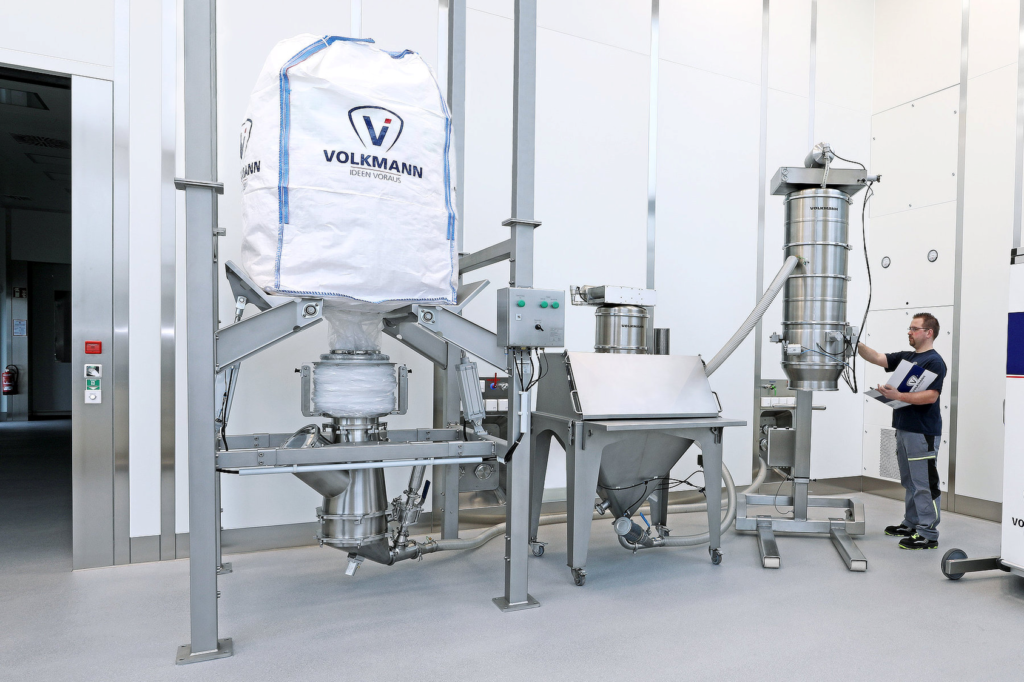
VOLKMANN designs enclosed, ATEX-certified vacuum conveying systems that integrate seamlessly into existing production lines, transferring powders, granules and other bulk materials safely, gently and dust-free. By automating material transfer, manual handling is significantly reduced while transfer rates are optimised, allowing downstream equipment to operate far closer to its intended capacity. The modular design can also be dismantled without tools, enabling rapid cleaning and faster product changeovers that keep production moving.
From raw material intake through to final packaging, the aim is to create a more connected process where materials arrive where they are needed, when they are needed, without compromise. Enclosed vacuum conveying provides the missing link, creating a reliable, automated flow between processes and helping existing equipment perform closer to its true potential.
Visit VOLKMANN UK on Stand K10 at PPMA to see our VS Vacuum Conveyor range and Rip & Tip Dump Station in action. Our engineering team will be on hand to discuss your process challenges and demonstrate how enclosed vacuum conveying and bulk material handling solutions can increase throughput, reduce manual handling, minimise downtime and remove bottlenecks.
*Source: IEEE Technology Navigator, “Throughput or Production Rate”
VOLKMANN UK Limited, Unit 4 Anglo Office Park, Lincoln Road, High Wycombe, Bucks, HP12 3RH, United Kingdom +44 (0) 1494 512228 | mail.uk@volkmann.info | https://uk.volkmann.info | https://www.linkedin.com/company/volkmann-uk-limited